
 Powers every SIMAC module
A beam model built on physics, not approximations.
The dose you plan is the dose you deliver. Verify dose against your accelerator's actual current state — and trace QA deviations to their physical root cause.
Our photon beam model is constructed directly from the physics of how your linear accelerator forms its beam — not from generic Monte Carlo spectra or empirical fits. Because it's physics-based, it can be refreshed whenever you choose, using the routine QA measurements you already take, with no full recommissioning. Characterize every field size from sub-centimeter to 40 cm from partial, large-field data — no exhaustive water-tank scanning.
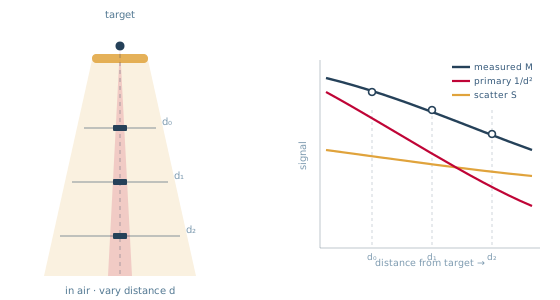
Unmix the scatter from the primary
Conventional models bolt scatter on with an empirical function peaked at beam center. SIMAC measures it instead — in air, with no phantom — reading the total signal at several distances from the target.
- Primary radiation falls off as 1/d² from the target — a point source
- Scatter radiates from the extended flattening-filter source, so it falls off differently
- Those distinct distance signatures let SIMAC solve for each independently — and keep both correct as energy shifts
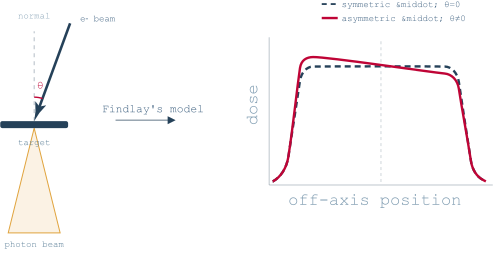
Model asymmetry from first principles
A symmetric photon beam depends on the electron beam striking the target at the right position and angle. If the electron beam drifts (which has many causes), the beam becomes asymmetric. SIMAC is the only beam model that can account for beam asymmetry.
- The accelerator beam model predicts the electron beam's position and angle of incidence on the target — from the electron beam path
- Findlay's analytic method turns that incidence into the photon spectrum and fluence — reproducing flatness and symmetry, including asymmetric beams
- So beam-steering adjustments show up correctly in the modelled profile — no fixed-symmetry assumption baked in
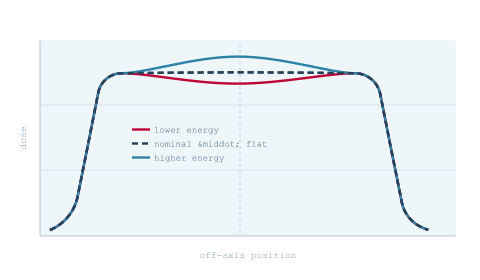
Flatness tracks beam energy
The flatness of the photon profile is set by the energy of the electron beam that strikes the target. As that energy changes, the profile flatness changes with it — through the same fixed flattening filter.
- Lower energy → a softer beam that horns at the field edges
- Higher energy → a more forward-peaked beam, peaked at the center
- Findlay's method recomputes the profile from the current energy — so a flatness change points straight back to an energy shift
Where it earns its place
Refresh from the same data and see the real dosimetric impact — not just a profile that technically passes.
When the beam runs soft between cycles, update on the spot so today's planning reflects today's beam.
After a target, MLC, or RF swap, refresh from routine QA to confirm the beam is dosimetrically equivalent.
Predict sub-centimeter dosimetry — including isocenter wander — from low-uncertainty large-field data.
Verify a complex plan against the machine's current true state instead of a separate phantom measurement.
Quantify the real patient-dose effect of a marginal QA failure before taking the machine offline.
What other physics is in the SIMAC Beam Model?
Each stage of beam formation is modelled from established physics, then tied to an update engine that keeps it current.
Component models (RF source, waveguide, gun, bending magnet, steering coils) predict electron energy, spectrum, position, angle, and current — via the load-line equation, not empirical fits.
A bremsstrahlung target model (Findlay's analytic method) reproduces flatness and symmetry, including asymmetric beams.
Head-scatter spectra (Sikora-based) plus ray-traced jaw and rounded-MLC-leaf penumbra, accurate from sub-cm to 40 cm.
Field-size-dependent kernels in any medium (water, bone, lung, implants) that inherently capture beam divergence.
Accounts for ~1 mm mechanical isocenter wander that affects small fields.
Compares routine QA to baseline, computes parameter adjustments, and refreshes on demand — plus a virtual water-tank simulation from partial measurements.
What it does — and doesn't do today
The SIMAC Beam Model is the physics engine behind the platform. Today it models photon beams; electron beams are not yet supported.
- ›Models photon beams from the real beam-forming physics
- ›Refreshes on demand from routine QA — no recommissioning
- ›Reproduces flatness, symmetry, and asymmetric beams
- ›Powers SIMAC Machine, Water Tank, QA, and Dose Calculation
- ›Photon beams only — electron beams are not yet available
- ›The model reflects your machine when you choose to refresh it from QA